
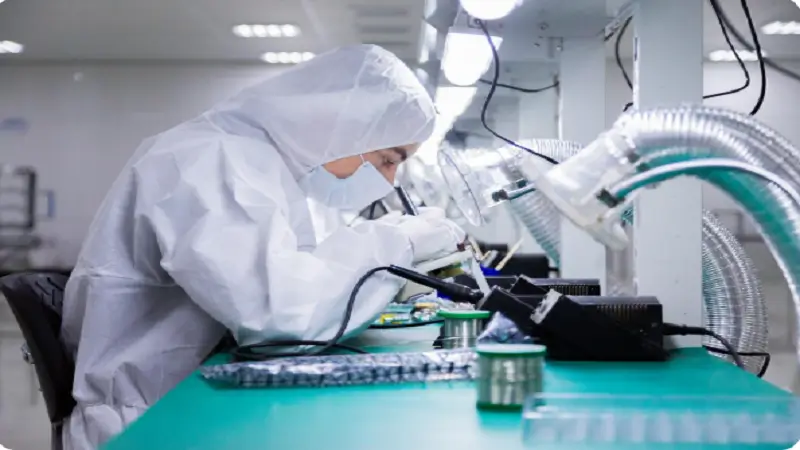
Semiconductor fabs run on the assumption that the air, water, and chemicals touching a wafer are cleaner than almost anything else on earth. At sub-10nm nodes, a single 2-nanometer particle landing in the wrong place can scrap an entire wafer, which is why microelectronics filtration has quietly become one of the most consequential pieces of the manufacturing stack. From point-of-use cartridges on lithography tools to AMC filters guarding cleanroom air, the technology directly shapes yield, equipment lifespan, and process stability.
This article looks at the contaminants that matter most, the filter types built to catch them, and where the field is heading next.
Key Takeaways
- Microelectronics filtration is essential in semiconductor manufacturing to control contaminants at the sub-nanometer scale and ensure ultra-clean conditions.
- Advanced filtration technologies, including membrane filters and AMC filters, protect delicate processes and materials from particles, metals, ions, and molecular contamination.
- Effective integration of filtration systems in cleanrooms enhances air and fluid purity, safeguarding critical tools like lithography machines and CMP equipment.
- Robust filtration directly improves manufacturing yield and device performance by minimizing defects and stabilizing process conditions.
- Innovations such as PFOA-free materials and 3D-printed filter geometries address evolving challenges in microelectronics filtration for smaller semiconductor nodes.
- Future smart filtration includes real-time contaminant monitoring and predictive maintenance to optimize semiconductor fab reliability and output quality.
The Critical Role of Filtration in Semiconductor Fabrication
Semiconductor fabrication involves intricate processes often exceeding 1,000 steps, each requiring an environment free from impurities. Contaminants in process gases, chemicals, ultrapure water (UPW), and slurries can cause defects, halt production lines, or damage sensitive tools. Filtration systems are essential to intercept particles, metals, ions, and airborne molecular contamination (AMC) throughout the fab facility. Suppliers like Pullner Filter in Songjiang District, Shanghai, operate large cleanroom manufacturing centers equipped with over 20 production lines, delivering high-performance cartridges and membrane filters suited for these stringent demands. Their advanced filtration products help ensure process consistency and long-term equipment stability by controlling contaminant levels at the sub-nanometer scale.
Key Contaminants Threatening Semiconductor Quality
In semiconductor manufacturing, several contaminants pose critical risks to product integrity. Sub-micron and nanometer-scale particles, sometimes as small as 2 nanometers, can render entire wafers defective. Metallic and ionic impurities often leach from wetted components, compromising chemical purity. Organic molecules and airborne molecular contamination (AMC) result from outgassing and chemical reactions involving photoresist materials. Dissolved gases such as oxygen, nitrogen, and carbon dioxide, along with microscopic bubbles in liquids, interfere with process uniformity. Moisture present in high-purity gases can also cause corrosion or defects. Effective filtration systems aim at mitigating these contaminants at every stage to secure semiconductor device longevity and yield.
Advanced Filtration Technologies Used in Microelectronics
Microelectronics production relies on a range of specialized filtration technologies. Membrane filters made from PTFE, PVDF, or PES materials handle chemicals, solvents, and ultra-pure gases with retention capabilities reaching around 1.5 to 2 nanometers. Depth filters manage high particle loads encountered with CMP slurry applications. Fluoropolymer cartridges resist harsh chemicals and elevated temperatures while maintaining low extractables, critical for sensitive processes. Gas purifiers use metal media filters suited for high-pressure, high-temperature environments to remove metallic and molecular contaminants. Degassing membranes and dissolved gas control modules optimize ultrapure water quality by reducing dissolved gases and bubbles. AMC filters maintain contaminant-free air within cleanroom environments and on the tool level, essential for controlling airborne molecular threats.
Integration of Filtration Systems Within Cleanroom Environments
Filtration systems are integrated tightly within semiconductor fab cleanrooms, ensuring critical environments meet stringent air and fluid purity standards. HEPA and ULPA filters manage particulate and molecular contamination in HVAC systems and localized clean zones. AMC filters provide additional protection near lenses and optical systems. Point-of-use filters are installed on essential tools like lithography machines, CMP equipment, wet benches, etch chambers, and deposition tools to safeguard against process contaminants. Multi-stage filtration setups are typical in ultrapure water plants and chemical distribution networks, including dedicated filtration for CMP slurry loops. Pullner Filter’s facilities in Shanghai exemplify modern integration strategies, producing high-quality filter cartridges designed for these specific cleanroom applications.
Impact of Filtration on Yield and Device Performance
Robust filtration translates directly into higher manufacturing yield and improved semiconductor device performance. By effectively removing killer defects and sub-nanometer particles, filtration minimizes wafer scrap rates, enhancing profitability. Stabilizing process conditions reduces variability, enabling tighter control over critical dimensions and electrical properties. Well-filtered inputs also protect costly equipment and delicate optics from premature wear or damage. For fabs running at the leading edge of technology nodes, these gains can be worth millions of dollars annually per tool. Pullner Filter’s expertise in producing precision filtration cartridges aimed at these exacting requirements helps semiconductor manufacturers safeguard their investment and maintain consistent output quality.
Challenges and Innovations in Microelectronics Filtration
As semiconductor devices scale to ever-smaller nodes, filtration demands intensify. Achieving finer particle retention with minimal pressure drop and reduced extractables presents ongoing challenges. Regulations like the EPA’s PFOA Stewardship have driven material innovations, including the adoption of PFOA-free fluoropolymers in cartridge manufacture. New filter media offer enhanced uniformity, for example, fiber metal composites and 3D-printed filter geometries that optimize fluid flow and contaminant capture. Pullner Filter’s investment in advanced cleanroom manufacturing allows rapid development and deployment of these innovative filter designs, ensuring compatibility with emerging semiconductor process chemistries and materials.
Future Trends: Smart Filtration and Real-Time Monitoring in Semiconductor Manufacturing
The next frontier in microelectronics filtration involves integrating smart sensors and real-time analytics directly into filtration systems. Online particle and AMC monitoring enable immediate detection of contaminant breakthroughs, allowing predictive maintenance before process disruption occurs. Such intelligent filtration solutions connect seamlessly with fab control systems to optimize filter life and performance. Tailored filter media are under development to address advanced process chemistries like silicon carbide (SiC) fabrication, novel CMP slurries, and hydrogen-based processes. Pullner Filter’s cutting-edge production capabilities position it to contribute to this evolution by manufacturing next-generation smart filters that anticipate fab needs and improve semiconductor manufacturing reliability.
About Pullner
Business: Pullner
Spokesperson: Lucy
Position: Sales Manager
Phone: 0086-21-57718597
Email: info@pullner.com
Location: LB19-Office No.1207, Jebel Ali Free Zone, Dubai, United Arab Emirates
Website: https://www.pullnerfilter.com/
Google Maps Link: https://maps.app.goo.gl/XgLZWHjGFcmdWddt6
Frequently Asked Questions About Microelectronics Filtration
What role does microelectronics filtration play in semiconductor manufacturing?
Microelectronics filtration is crucial in semiconductor manufacturing to remove contaminants like particles, metals, ions, and airborne molecules that can cause defects, equipment damage, and line stoppages, ensuring high yield and device performance.
Which contaminants are most harmful to semiconductor fabrication quality?
Key contaminants include sub-nanometer particles down to 2 nanometers, metallic and ionic impurities, organic molecules and airborne molecular contamination (AMC), dissolved gases like oxygen and carbon dioxide, microscopic bubbles, and moisture in high-purity gases.
What advanced filtration technologies are used to control contaminants in semiconductor fabs?
Technologies include membrane filters (PTFE, PVDF, PES) retaining particles as small as 1.5–2 nm, depth filters for CMP slurry, fluoropolymer cartridges with high chemical resistance, metal media gas purifiers, degassing membranes, and AMC filters for cleanroom air quality.
How are filtration systems integrated within semiconductor cleanroom environments?
Filtration is integrated via HEPA/ULPA and AMC filters in HVAC and localized clean zones, point-of-use filters on critical tools like lithography and CMP equipment, and multi-stage filtration in ultrapure water plants and chemical distribution networks to maintain ultra-clean conditions.
Why is microelectronics filtration critical for improving semiconductor manufacturing yield?
Effective filtration removes killer defects and sub-nanometer contaminants that cause wafer scrap, stabilizes processes, and protects sensitive equipment and optics, leading to higher die yield and better device reliability, often translating to millions saved per tool annually.
What future innovations are expected in microelectronics filtration for semiconductors?
Future trends include smart filtration systems with real-time particle and AMC monitoring, predictive maintenance, tighter fab control integration, and development of tailored filter media for advanced chemistries like silicon carbide and hydrogen-based processes, enhancing reliability and performance.See More