
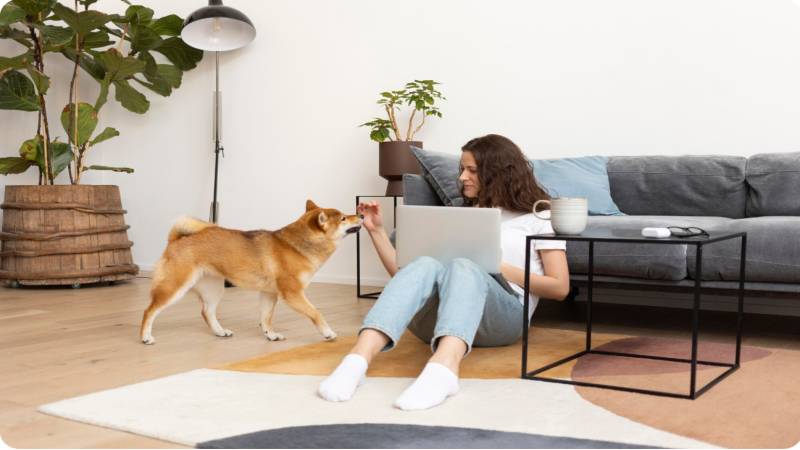
Choosing a floor for a home renovation becomes more complicated when cats and dogs share the space. A floor that looks excellent in a showroom can become scratched, slippery, stained, noisy, or difficult to clean after a few months of real pet life.
Pet-friendly flooring also means more than finding the hardest material available. A Great Dane has different needs from an indoor cat. A puppy creates different problems from a 13-year-old dog with stiff joints. A house with direct backyard access deals with mud and water that a high-rise apartment rarely sees.
The right decision therefore starts with the animal rather than the flooring catalog. Traction, moisture resistance, scratch resistance, comfort, noise, cleaning, and repairability all matter. Price matters too, but spending more does not automatically produce a floor that works better with pets.
Current U.S. flooring costs illustrate how wide the choices are. Installed laminate commonly falls around $3 to $13 per square foot, engineered hardwood around $7 to $20, cork roughly $5 to $19, porcelain tile around $9 to $50, and polished concrete roughly $2 to $16 depending on the finish and existing slab.
The goal should not be to find a supposedly indestructible floor. It should be to build a home where pets can move comfortably while owners can clean, maintain, and live with the flooring for years.
1. Your Pet Tests a Floor Differently Than You Do
Traction should be one of the first questions in a pet-friendly renovation. Humans can cross polished wood or glossy tile without thinking about it, while dogs rely heavily on their paws maintaining grip as they accelerate, turn, stand up, and stop.
This becomes particularly important as dogs age. VCA Animal Hospitals specifically recommends improving traction for dogs with osteoarthritis because slippery floors can make walking, turning, and standing more difficult. Rugs, non-slip surfaces, and other traction aids can help dogs move around the home more comfortably.
A renovation intended to last 15 or 20 years should therefore consider the pet’s future needs as well as today’s behavior. A three-year-old Labrador may sprint across polished hardwood without difficulty today. The same dog could struggle with that surface at age 11.
Texture matters more than many homeowners realize. Matte finishes, subtle embossing, lightly textured tile, and brushed wood generally provide a more forgiving surface than mirror-smooth finishes. Texture also hides small scratches, dust, paw marks, and hair better.
Scratch resistance creates a different challenge. Dogs put repeated pressure on the floor through their nails, particularly while running or changing direction. Large active dogs create much more stress than a small dog walking slowly through the house.
Cats usually create a different wear pattern. Their litter can spread abrasive particles around the floor, while spilled water, hairballs, food, and litter-box accidents create localized cleaning problems. Owners also need surfaces that tolerate frequent vacuuming and wiping.
Water resistance becomes essential near entrances and feeding stations. A dog returning from a rainy yard can bring water across several rooms. A poorly positioned water bowl may create small spills every day for years.
Repeated moisture deserves more attention than dramatic accidents. One puppy accident that gets cleaned immediately may cause no damage. Water seeping between floorboards beside a drinking bowl every day can eventually create swelling, discoloration, or odor problems.
Noise also matters. Hard floors amplify claws. A dog walking through an upstairs hallway at 2 a.m. may sound surprisingly loud downstairs. Floating laminate can sound hollow without good underlayment, while tile and concrete reflect sound around an open room.
Comfort completes the picture. Tile and concrete are extremely durable, but they are hard. Cork is warmer and softer but easier to damage. Wood sits somewhere between those extremes.
These differences explain why the same recommendation should not apply to every household.
A family with two large dogs and a backyard needs exceptional resistance to moisture, grit, and scratching. An apartment with two indoor cats can reasonably prioritize appearance and cleaning. A household with a senior dog should move traction much higher on the list.
Pet-friendly flooring begins with identifying which problem the home actually needs to solve.
2. Putting the Main Flooring Choices Through a Real Pet Test
Luxury vinyl plank has become one of the easiest starting points for homes with dogs because it combines water resistance, relatively easy cleaning, and convincing wood designs.
Better LVP products offer thick wear layers designed to protect the printed surface underneath. As a current retail example, Home Depot lists Lifeproof Sterling Oak waterproof click-lock LVP with a 30-mil wear layer at about $2.99 per square foot for the material at the time of writing. A 22-mil version is listed around $3.28 per square foot. Prices can change by promotion and location.
Those numbers demonstrate another important point: wear layer and overall durability do not always correspond neatly with price. Homeowners should compare specifications rather than assuming that the most expensive plank is automatically tougher.
Across the broader market, LVP materials can range from roughly $1.50 to $12 per square foot, while professional vinyl labor can add about $1 to $10 per square foot depending on preparation and complexity.
Vinyl’s greatest pet advantage is moisture management. Waterproof click-lock systems work well around entrances, kitchens, and feeding areas. Mud can be wiped away without homeowners panicking every time a dog comes through the door.
Vinyl is not indestructible. Heavy furniture can dent some products, sharp objects can gouge them, and cheaper finishes can look artificial. Very smooth vinyl may also provide less traction than a textured plank.
Porcelain tile approaches the problem from the opposite direction. It sacrifices softness for durability.
Dog nails will struggle to meaningfully scratch quality porcelain under normal household conditions. Water, urine, mud, and food can usually be cleaned quickly. That makes porcelain particularly useful in mudrooms, kitchens, laundry rooms, and entrances connected directly to gardens.
Tile also works well with radiant floor heating. Without heating, however, it can feel cold in winter. Its hardness can also make long periods of standing or lying less comfortable.
Surface selection matters. Highly polished porcelain may look dramatic under showroom lighting but can be a poor choice for a dog that races through the kitchen. Matte or textured finishes generally make more sense.
Current professional porcelain installation ranges widely at roughly $9 to $50 per square foot including materials and labor, according to Angi. The tile itself can cost far less; complex layouts, preparation, leveling, and labor push finished projects higher.
Porcelain’s durability is one reason similar hard surfaces appear in environments exposed to constant spills, cleaning, chairs, and movement around restaurant tables. A home does not face exactly the same traffic, but an energetic dog can make durability surprisingly important.
Laminate occupies a useful middle position for budget-conscious renovations. Modern laminate is considerably more sophisticated than the hollow, obviously artificial floors many people remember from older installations.
Some current waterproof laminate products cost less than premium vinyl. For example, Home Depot lists several Pergo Outlast+ waterproof laminate patterns at approximately $2.69 to $2.79 per square foot for materials.
Professional laminate installation averages around $3 to $13 per square foot, including a broad range of material and project conditions. Materials alone often sit around $1 to $5 per square foot.
Laminate’s tough surface can handle dog nails well, but water remains the detail to investigate carefully. Products marketed as waterproof or highly water-resistant should be installed according to the manufacturer’s perimeter, expansion, and sealing instructions. One weak transition near an exterior door can undermine an otherwise good installation.
Acoustics also deserve attention. A cheap floating laminate installed over inadequate underlayment can produce noticeable clicking when pets walk across it.
Engineered hardwood suits owners who want actual wood rather than a wood image.
Pets do not automatically eliminate hardwood from consideration. They simply change the type of wood and finish that makes sense.
A matte or brushed oak floor will generally disguise daily wear better than dark, glossy wood. Variation in the grain also helps small marks blend into the surface.
Owners should understand that wood develops signs of use. If every scratch will cause frustration, natural wood may be the wrong material for a highly active dog household regardless of budget.
Current engineered hardwood installation runs roughly $7 to $20 per square foot, with a 500-square-foot installation averaging about $6,750 in HomeAdvisor’s current data.
Engineered wood makes more sense in a home with one indoor cat or a calm medium-sized dog than in a mudroom serving two large dogs after every rainy walk.
Cork deserves more attention for homes where comfort and noise matter.
Cork has natural underfoot and absorbs sound better than many hard floors. Those characteristics can make it attractive for offices, bedrooms, or spaces used heavily by older pets.
Its weakness is toughness. Furniture can dent cork, claws can damage the finish, and prolonged moisture requires careful management. Angi currently places installed cork flooring at roughly $5 to $19 per square foot, with many typical projects falling closer to $5 to $14.50.
Cork should therefore be chosen because its particular qualities suit the room, not because it is marketed as an unusual eco-friendly alternative.
Polished concrete represents another extreme.
An existing concrete slab can be ground, sealed, stained, and polished into a highly durable finished floor. Current polishing costs commonly fall around $2 to $16 per square foot, depending heavily on the condition of the slab and decorative treatment.
Concrete handles claws, grit, and heavy traffic exceptionally well. It can also work beautifully with radiant heating.
The disadvantages are hardness and traction. Highly polished surfaces can become slippery, and a hard floor gives an older dog little cushioning. Strategic washable rugs can solve part of the problem without hiding the entire floor.
Traditional carpet reverses those characteristics. It offers grip, warmth, and cushioning but performs poorly when repeated urine, mud, vomit, and shedding enter the equation.
The carpet does not need to disappear completely. Bedrooms, runners, washable rugs, and modular carpet tiles can provide soft zones while keeping vulnerable materials away from entrances and feeding areas.
3. The Best Pet Floor May Actually Be Three Different Floors
Using one floor throughout the entire house looks visually simple, but pet behavior changes from room to room.
The entrance takes the worst punishment. Water, grit, small stones, mud, and occasionally road salt arrive on paws. This zone benefits from porcelain, waterproof vinyl, or another surface that tolerates aggressive cleaning.
The kitchen has different risks. Food drops, water bowls spill, and pets often spend time near family members while meals are prepared. Water resistance becomes more important than extreme scratch resistance.
The living room needs a more balanced approach. People care about appearance here, pets spend significant time there, and the room may connect directly to an entrance. Quality LVP, engineered wood, or textured laminate can all work depending on the household.
Bedrooms allow greater freedom. A dog is unlikely to arrive directly from a muddy yard into an upstairs bedroom several times per day. Cork, engineered wood, carpet, or other warmer materials become more reasonable.
Stairs deserve separate treatment because slips on stairs carry greater consequences than slips across a flat room.
The American Kennel Club notes that senior dogs may find hardwood and other slippery surfaces difficult and recommends solutions such as grippy coverings or anti-slip surfaces.
A hardwood staircase can therefore benefit from a fitted runner even when owners prefer exposed timber elsewhere.
Cat owners should create their own zones around litter boxes. Litter granules spread farther than expected and can become trapped in carpet fibers. Smooth floors paired with large litter-catching mats make vacuuming much easier.
A practical 1,500-square-foot renovation might use porcelain in a 100-square-foot mudroom, waterproof LVP across 750 square feet of kitchen and living space, and engineered oak across 650 square feet upstairs.
Different flooring does not have to make the house look fragmented. Similar colors can connect materials visually. A light oak LVP downstairs can transition into real light oak upstairs. Wood-look porcelain beside an exterior door can continue the same general tone.
Plank dimensions also help. Floors feel more connected when tile or vinyl proportions visually relate to adjacent wood rather than changing abruptly from wide contemporary planks to tiny traditional tiles.
Transitions should be planned before installation. Height differences between porcelain, underlayment, LVP, and wood can create awkward ridges if contractors treat each room independently.
The multi-floor approach can also control spending. Expensive engineered wood can remain in spaces where homeowners appreciate it most, while durable vinyl handles areas where real wood would require constant caution.
Pet-friendly renovation therefore becomes a zoning exercise rather than a search for one miracle product.
4. The Floor Material Is Only Half the Renovation
Subfloor conditions can turn an affordable project into an expensive one.
Removing the existing flooring may reveal cracked concrete, damaged plywood, old adhesive, moisture problems, or uneven sections. Floating floors still need a sufficiently flat foundation. Tile needs a stable substrate. Wood needs appropriate moisture conditions.
Current national estimates illustrate why homeowners should keep money aside for preparation. Angi puts general flooring installation for 500 square feet at roughly $1,528 to $4,859, but notes that subfloor replacement and underlayment can add substantial costs.
Cork projects may require approximately $3 to $5 per square foot for leveling, while subfloor repairs can add about $2 to $10 per square foot in some cases.
A homeowner comparing a $2.50 plank with a $4 plank may therefore be focusing on the smallest part of the financial difference.
Buyers should ask flooring contractors for separate lines covering demolition, disposal, leveling, moisture treatment, underlayment, flooring, installation, trim, doors, stairs, and transitions.
Texture should receive similar attention.
Owners frequently choose flooring based on a small sample held vertically under bright store lighting. Pets experience it horizontally while moving at speed.
Take the sample home. Put it on the floor. Let the dog walk across it. Compare it beside the current flooring.
A large energetic dog may visibly hesitate on one sample and walk normally across another.
Color affects maintenance more than durability. Dark uniform floors expose light-colored fur, dust, dried water marks, and scratches. Very pale floors can reveal mud.
Mid-tone flooring with visible grain or pattern usually hides everyday pet mess better.
Grout choice matters on tile. Narrow joints and stain-resistant grout simplify cleaning around entrances and food bowls. Bright white grout beside a garden door may require far more maintenance than a medium neutral color.
Underlayment matters on floating floors. A good acoustic layer can soften the hollow noise created by paws and nails, particularly on upper stories.
Baseboards deserve protection too. Wet dogs shake water horizontally, not politely downward. Washable wall paint and moisture-resistant trim near entrances can prevent the newly renovated floor from being surrounded by damaged walls.
Feeding stations should receive simple protection even when the floor itself is waterproof. A large silicone or rubber mat catches water and food before debris reaches seams and wall edges.
Exterior design can reduce indoor damage further. A coarse outdoor mat followed by an absorbent indoor mat creates two stages of dirt removal before the pet reaches the finished floor.
Regular nail maintenance also changes how the floor performs. VCA specifically notes that keeping a dog’s nails appropriately short can improve traction.
The smartest pet renovations combine material choice with these inexpensive details.
5. Three Budgets and Three Very Different Pet-Friendly Homes
A budget renovation should prioritize correct installation over impressive branding.
Consider a 1,000-square-foot home that needs new flooring across most living areas. A durable waterproof laminate at roughly $2.50 to $3.50 per square foot could put material near $2,500 to $3,500 before waste, trim, preparation, and labor.
Current Pergo Outlast+ examples around $2.69 to $2.79 per square foot show that recognizable waterproof laminate does not necessarily require premium wood-level spending.
The owner should resist spending every remaining dollar on a more expensive plank. Correct leveling and decent underlayment can matter more.
A mid-range pet renovation can mix materials.
Take a 1,500-square-foot suburban home with two dogs.
Use porcelain for a 120-square-foot mudroom at perhaps $15 per square foot installed, producing roughly $1,800 for that zone. The price could be considerably higher with expensive tile or difficult preparation.
Use a quality 22- or 30-mil LVP throughout 800 square feet of kitchen, dining, and living space. At $3 per square foot for material, flooring alone would be around $2,400 before waste and installation.
Use durable laminate upstairs across 580 square feet at around $3 per square foot in materials, adding roughly $1,740.
The material portion might therefore sit around $6,000 before underlayment, trim, removal, preparation, delivery, and labor. Actual installed cost could rise substantially depending on local conditions.
A premium renovation can cost more without abandoning practicality.
Consider owners who want natural oak across their main living spaces but also own a large dog.
They might install engineered oak through the living room and bedrooms while using high-quality wood-look porcelain around exterior entrances and waterproof LVP in a lower-level family room.
At $12 per square foot installed, 1,000 square feet of engineered hardwood would cost about $12,000. At $20 per square foot, the same area reaches $20,000. Those figures fit within today’s broad $7-to-$20 installed range for engineered hardwood.
The premium decision should focus less on buying the most expensive wood and more on choosing an appropriate finish. A lightly brushed, matte oak can age more gracefully around pets than a dark glossy floor costing considerably more.
Owners with senior dogs should adjust the budget differently.
Instead of spending thousands to replace every durable hard floor, they may gain more practical value from installing permanent stair runners, large non-slip rugs, softer resting areas, and better traction along the routes the dog uses most.
VCA’s guidance for dogs with osteoarthritis specifically recommends non-slip walking surfaces, including rugs or other traction aids, because slick flooring can interfere with normal movement.
That makes the final flooring decision easier to frame.
Choose waterproof LVP when the priority is balancing appearance, moisture resistance, cleaning, and cost.
Choose textured porcelain when durability and water resistance dominate and hardness is acceptable.
Choose engineered hardwood when having real wood matters enough to accept scratches and maintenance as part of ownership.
Choose laminate when the budget is tighter but scratch resistance and realistic wood visuals still matter.
Consider cork where quietness, warmth, and softer footing matter more than maximum resistance to claws and water.
Consider polished concrete when the house already has a suitable slab and the owners want a durable contemporary surface, but avoid assuming that the glossiest finish is the best one for pets.
Most importantly, renovate for the pet that will live on the floor rather than the floor sample that looks best under showroom lights. A young dog will age. Puppies have accidents. Cats track litter. Water bowls spill. Mud arrives after rain.
A successful pet-friendly floor accepts those realities without forcing owners to treat their home like a protected display space.
The best renovation is often a combination: durable flooring in high-risk zones, warmer materials where appropriate, non-slip surfaces along important routes, washable rugs where animals rest, and enough visual texture to disguise everyday wear.
That approach gives pets a home they can actually move through comfortably while giving owners flooring they do not need to worry about every time they hear paws running down the hallway.See More