
Excavation projects often begin with a common assumption that utility locate requests will identify every buried line on a property. In reality, many underground systems remain unmarked after standard public locates are completed.
For contractors, landscapers, builders, and property owners in London, Ontario, this misunderstanding can create significant safety and financial risks. Damaging buried electrical lines, communication cables, irrigation systems, or private gas infrastructure can delay projects, interrupt services, and create dangerous working conditions.
Private utility locating helps close this gap by identifying underground infrastructure that falls outside the scope of public utility marking systems. As excavation activity continues across residential and commercial properties in London, understanding the role of private locating services has become increasingly important for safe project planning.
Public Utility Locates Do Not Identify Every Buried Service
Ontario digging regulations require contractors and property owners to request public utility locates before excavation begins. These locate requests are essential, but they only apply to infrastructure owned by participating public utility providers.
This means many underground systems located on private property may remain unidentified after standard locates are completed.
Examples of commonly unmarked private infrastructure include:
- Electrical lines beyond the meter
- Private communication cables
- Parking lot lighting circuits
- Irrigation systems
- Private gas lines
- Underground water services
- Security and data cabling
For excavation crews, assuming all buried infrastructure has been marked can lead to accidental utility strikes. Even shallow digging activities such as fence installation, trenching, landscaping, or drainage work can damage underground systems if additional locating is not performed.
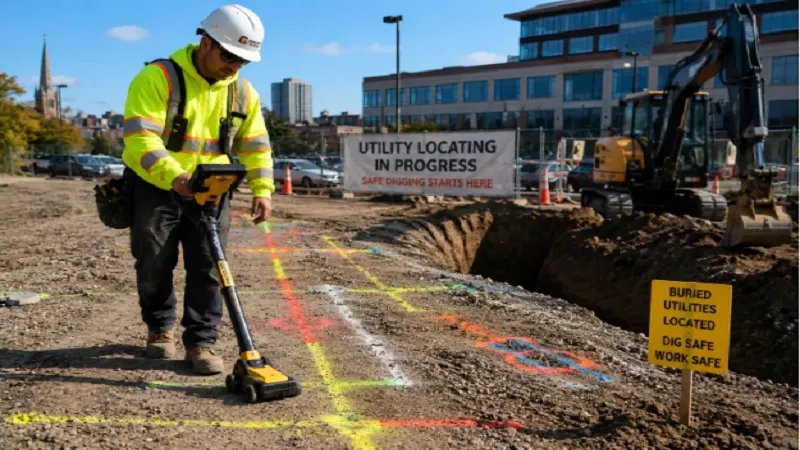
Underground utility locating helps contractors gain a more complete understanding of what exists below the surface before excavation equipment is used.
Excavation Safety Depends on Accurate Utility Information
Excavation safety begins long before digging starts. One of the most important parts of excavation planning is identifying hidden risks that could affect workers, nearby structures, or active utility systems.
Buried cable detection is especially important on commercial and industrial sites where properties may contain decades of undocumented infrastructure upgrades. Renovations, additions, and site improvements often leave behind buried systems that are not reflected in updated site plans.
Striking underground utilities can create several immediate problems:
- Electrical hazards for workers
- Damage to surrounding infrastructure
- Emergency repair costs
- Delays to construction schedules
- Service interruptions for tenants or businesses
- Regulatory investigations and liability concerns
Even relatively small utility strikes can affect multiple trades and delay broader construction timelines. By locating underground infrastructure before excavation begins, contractors can make safer decisions regarding trench routes, equipment placement, and digging depth.
Safe digging practices are not only about regulatory compliance. They are also a practical way to reduce uncertainty and improve job site coordination.
Private Utility Detection Supports Better Project Planning
Private utility detection uses specialized equipment to identify buried infrastructure that may not appear in municipal or utility records. Technologies such as electromagnetic locating equipment and Ground Penetrating Radar can help technicians trace underground systems across private properties.
These services are commonly used before:
- Parking lot excavation
- Landscaping projects
- Commercial trenching
- Drainage installation
- Electrical upgrades
- Site redevelopment work
- Foundation construction
Buried utility mapping allows project teams to better understand site conditions before excavation begins. This information can reduce unnecessary exploratory digging and help contractors avoid changing plans after work is already underway.
For property managers and facility owners, locating private utilities can also help protect ongoing building operations. Damaging communications lines, lighting systems, or underground power feeds may affect tenants, security systems, or business continuity.
In many cases, excavation risks are highest on older properties where underground infrastructure records are incomplete or outdated.
Why Private Property Requires Additional Attention
Many contractors are surprised to learn how much underground infrastructure exists beyond municipal responsibility. Public utility owners generally maintain lines up to a defined service point, but systems installed after that point are often privately owned.
This distinction is important during excavation planning because public locate providers may not mark those private systems automatically.
For example, a commercial plaza may contain privately owned electrical distribution lines running between buildings or parking lot lighting systems installed years after original construction. Residential properties may include detached garage power feeds, irrigation controls, or backyard communication lines that are not included in public locate databases.
To reduce excavation risks on private property, many contractors now use private utility locates London services before trenching or mechanical excavation begins.
Additional locating support is particularly valuable during redevelopment and renovation projects where existing underground conditions may be difficult to verify through documentation alone.
Utility Locating Helps Protect Infrastructure and Schedules
Modern excavation projects depend on accurate site information. As underground infrastructure becomes more complex, utility locating has become an increasingly important part of contractor safety procedures and construction planning.
Private locating services help excavation teams:
- Reduce the risk of utility strikes
- Improve worker safety
- Avoid emergency repairs
- Protect underground infrastructure
- Minimize costly project delays
- Improve coordination between trades
For contractors working in London’s residential, commercial, and industrial sectors, utility locating is often one of the most effective ways to reduce uncertainty before digging begins.
Rather than relying solely on assumptions or incomplete records, excavation crews can make informed decisions based on verified underground conditions. This proactive approach supports safer job sites, more efficient workflows, and better protection for the buried systems that keep properties operational.See More