
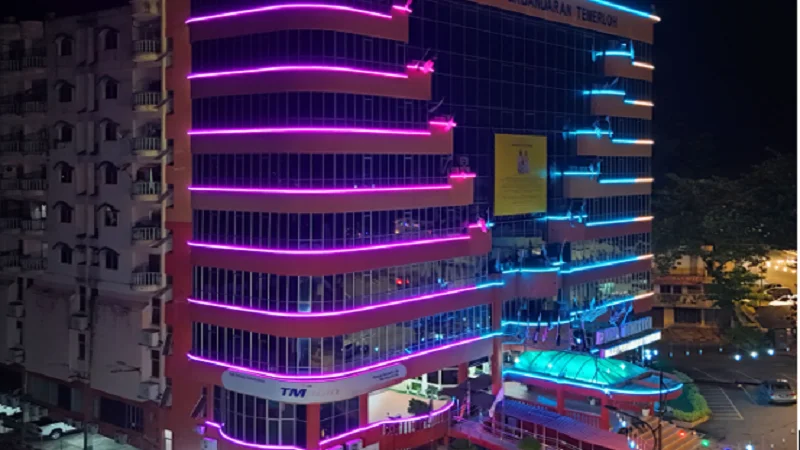
For contemporary architects and lighting engineers, the integration of linear light into the built environment has moved beyond simple decorative accenting. It is now a structural element that defines the silhouette of skyscrapers, ensures the safety of public transit hubs, and enhances the fluidity of modern interiors.
However, the successful execution of a large-scale project depends on more than just aesthetic vision; it requires a rigorous understanding of electrical engineering, thermal dynamics, and material durability. When sourcing wholesale LED strip lights, professionals must look beyond the surface glow to evaluate the technical architecture that ensures a maintenance-free lifecycle.
Electrical Engineering: Solving the Voltage Drop Equation
The most significant technical hurdle in large-scale neon LED installations is “Voltage Drop.” This phenomenon occurs because the copper traces within the flexible PCB act as resistors. As the current travels further from the power source, energy is lost as heat, leading to a visible decrease in brightness and color shifting at the end of the run.
The Calculation Logic
To mitigate this, engineers must calculate the maximum run length based on the gauge of the copper (measured in ounces) and the total wattage. The formula used is Vdrop = I × R, where I is the current and R is the resistance of the PCB traces.
- 3oz Copper PCBs: These are the industry standard for high-end projects, allowing for longer runs by reducing the R value.
- 48V Systems vs. 24V Systems: For expansive architectural facades, moving from a 24V system to a 48V system is a strategic choice. Since P = V × I, doubling the voltage halves the current required for the same power output. Lower current results in significantly less voltage drop, allowing for single-ended power feeds of up to 50 meters in some constant-current configurations.
Power Infrastructure and Load Management
In a project involving thousands of meters of neon flex, the placement and capacity of Power Supply Units (PSUs) are critical.
Derating Factor for Longevity
A common engineering error is loading a power supply to its maximum capacity. Professional standards dictate a 20% derating rule. If a project requires 80W of power, a 100W PSU should be specified. This head-room prevents the PSU from overheating, reduces acoustic noise (coil whine), and ensures the components within the driver (especially electrolytic capacitors) do not reach their thermal limit prematurely.
Centralized vs. Decentralized Power
- Centralized: Placing all drivers in a dedicated electrical room. This simplifies maintenance but requires heavy-gauge “feeder wires” to prevent voltage drop between the room and the lights.
- Decentralized: Placing drivers closer to the strips (e.g., inside ceiling coves). This reduces feeder wire costs but complicates access for future repairs. Architects must design “access panels” that are both functional and invisible to the public eye.
Thermal Management in Enclosed Architectural Pockets
While LEDs are far more efficient than incandescent bulbs, they are not 100% efficient. Approximately 70% of the energy consumed is still converted into heat. In the confined spaces of an architectural “cove” or a recessed floor channel, this heat can build up rapidly.
The Role of Aluminum Extrusions
Every professional neon LED installation should utilize an aluminum mounting track. Aluminum serves as a “Heat Sink” with a high thermal conductivity coefficient (approx. 205 W/m·K). Without this, the junction temperature (Tj) of the LED chips can exceed 85°C, leading to a permanent shift in color temperature (CCT) and a rapid decline in lumen maintenance (L70).
- Thermal Interface Materials (TIM): In extreme cases, a thermal adhesive or pad is used between the neon strip and the aluminum track to ensure zero air gaps, maximizing heat transfer.
Signal Integrity for Addressable Media Facades
When the project involves “Addressable Neon” (where each pixel is controlled individually), the complexity shifts from power to data.
Data Attenuation and Refresh Rates
Addressable systems use protocols like DMX512 or SPI. Over long distances, the data signal can degrade (attenuation).
- Signal Buffers: For runs where the controller is more than 10 meters from the first pixel, “Signal Amplifiers” or “Null Pixels” must be installed to regenerate the data pulse.
- Frame Rate (FPS): For fluid color chases, a high refresh rate is required. Engineers must calculate the “Universe” capacity of the DMX controller. One DMX universe supports 512 channels—if using RGB neon, that’s 170 individual pixels per universe. Large facades may require dozens of universes synced via Art-Net or sACN protocols.
Ingress Protection (IP) and Environmental Stress
Architects must specify the correct IP rating based on the “Micro-Climate” of the installation site.
- IP65: Suitable for indoor splashes (e.g., bathrooms).
- IP67: Required for general outdoor use where the strip may be subject to heavy rain and temporary flooding.
- IP68: Mandatory for submersed applications like fountains or swimming pools.
- The “Breathing Effect”: One of the most common failures in outdoor neon is water ingress caused by pressure differentials. As the light heats up, air is pushed out; as it cools, moist air is sucked in. High-quality wholesale neon strips utilize “Breathing Valves” or integrated silicone end-caps that are factory-molded rather than glued to prevent this vacuum effect.
Compliance with Building Codes and Safety Standards
Professional engineering requires adherence to international safety standards.
- Class 2 Power Units: In the US (UL standard), a Class 2 circuit is limited to 96W at 24V. This is a safety standard designed to prevent electric shock and fire. Large projects must be broken down into multiple 96W “Class 2” segments to comply with the National Electrical Code (NEC).
- Plenum Rating: For installations inside air-handling spaces (ceilings used for air circulation), the neon strip and its wiring must be “Plenum Rated” (UL 2043), meaning they emit low smoke and no toxic fumes in the event of a fire.
- Flame Retardancy: Silicone is naturally more flame-retardant than PVC. High-grade silicone neon strips often meet the UL94-V0 standard, which means the flame extinguishes itself within 10 seconds.
Mechanical Stress and Minimum Bend Radius
Architects often design complex curves that push the physical limits of the material.
- The Bend Radius Limit: Every neon strip has a “Minimum Bend Radius.” Forcing a strip into a tighter curve than specified can crack the internal copper traces or delaminate the LED chips from the PCB.
- Orientation Matters: You must specify whether the project requires a “Top-Bend” (vertical flexibility) or a “Side-Bend” (horizontal flexibility) strip. Attempting to bend a strip in the wrong axis will cause immediate and irreparable mechanical failure.
Conclusion: The Engineering of Permanent Glow
The successful integration of linear lighting into modern architecture is a feat of multidisciplinary coordination. It is the intersection where the artistic vision of the architect meets the cold, hard calculations of the electrical engineer. A project’s success is not measured on the night of the “grand opening,” but five years later, when the light remains as consistent and vibrant as day one.
For the specifier, the sourcing stage is where the battle is won or lost. Investing in bulk LED neon flex that adheres to strict copper weights, thermal management protocols, and signal integrity standards is the only way to ensure the structural integrity of the light. By treating the neon LED system as a core building component rather than a decorative addition, architects can create luminous landmarks that stand the test of time, weather, and technological evolution.See More