
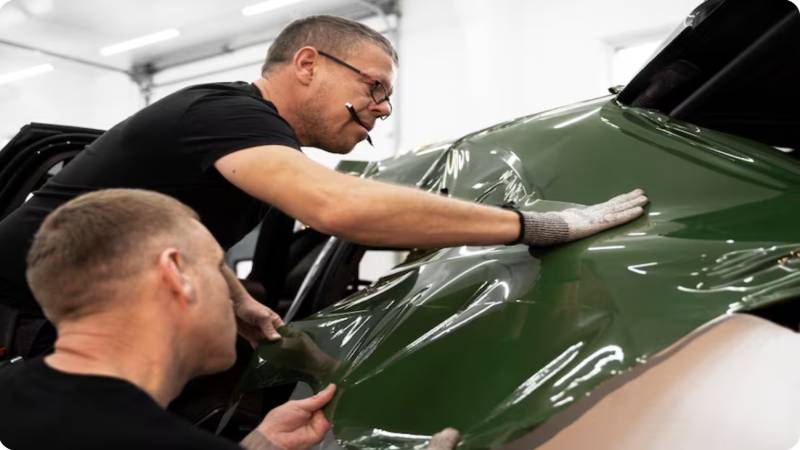
Every spring in the GTA, body shops fill up with the same job: touching up rock chips across the front bumper and hood of cars that looked fine in October. The culprit is rarely dramatic. It is a winter of highway gravel, a season of brine trucks, and a few thousand kilometres of Highway 400 at 110 km/h. Paint protection film, the clear urethane layer most people still call a clear bra, exists to take that damage instead of your paint. This guide walks through what the film actually is, what it protects against, what it costs in the Vaughan and wider Toronto market right now, how it compares to ceramic coating, and the questions that separate a good installer from a cheap one.
None of this is complicated once you strip out the marketing language. Most of it comes down to physics, climate, and how carefully someone cuts and tucks a sheet of film.
What Is Paint Protection Film, in Plain Terms?
Paint protection film is an ultra-thin, transparent thermoplastic polyurethane (TPU) layer, roughly 6 to 8 mil thick, applied over a vehicle’s painted surfaces to absorb impacts that would otherwise chip or scratch the paint. It sits on top of the clear coat as a sacrificial barrier: rocks, sand, and road debris hit the film, not the finish underneath.
The “self-healing” part is the feature people find hard to believe until they see it. The top layer of quality PPF is an elastomer, which means light swirl marks and fine scratches close back up when the film warms. In practice, that is warm water, a heat gun, or a hot summer day, roughly above 20C. The scratch was only in the flexible top coat, so heat lets the polymer flow back to its original shape. Deep cuts that reach the adhesive do not heal, but the daily wash-and-drive scuffs that dull most cars do.
Good film is also hydrophobic, meaning water beads up and rolls off rather than spreading and clinging. A hydrophobic surface is one that naturally repels water, causing droplets to form instead of sheeting out, which is why a filmed panel sheds rain, road grime, and salt spray faster than bare clear coat. The MIT explainer on hydrophobic and hydrophilic surfaces lays out the mechanism if you want the surface-chemistry version: it comes down to the contact angle between the droplet and the surface.
A few terms worth pinning down before we go further, because installers use them loosely:
- Paint protection film, or clear bra: a clear urethane film applied to paint to take physical impacts, chips, and abrasion.
- Self-healing TPU: the elastomeric top layer of quality film that reflows and closes minor scratches when warmed.
- Ceramic coating: a thin, hard, liquid-applied glass-like layer that bonds to the paint for gloss and easy cleaning, with no meaningful chip protection.
- Hydrophobic layer: a surface treatment that makes water bead and roll off rather than spread and cling.
What PPF Actually Protects Against
The short answer: physical and chemical attacks on the paint that you cannot see coming. The film is a barrier, so it stops things that touch the surface. It does the following well:
- Rock and stone chips: the main reason people buy it, concentrated on the bumper, hood leading edge, and mirrors.
- Road debris and sand: the constant low-grade sandblasting of highway driving.
- Road salt and brine: winter de-icing chemicals that sit on paint and accelerate corrosion at any chip or scratch.
- UV exposure: quality film blocks ultraviolet light, which is what breaks down clear coat over years.
- Wash-induced micro-scratches: the fine swirls from automatic car washes and dirty microfibre towels.
- Bird droppings and acidic contaminants: droppings, tree sap, and bug splatter that etch bare clear coat if left to bake in the sun.
What it does not do is stop a shopping cart, a door ding, or a collision. It is chip and abrasion protection, not armour.
Why the Vaughan and GTA Climate Makes It Worth Considering
Southern Ontario is a genuinely hard environment for automotive paint, and the reasons are seasonal and opposite. Winter is a corrosion problem. Summer is a UV problem.
In winter, the region runs on salt and brine to keep roads drivable, and salt is rough on vehicles. York Region’s own public messaging is blunt about it: as the region’s Salt Responsibly campaign notes, salt accelerates rusting, causing damage and increasing repair costs to vehicles. Every stone chip from November onward becomes an entry point where salt can start corrosion under the paint. Film that has already sealed those high-impact panels keeps the salt off the metal.
In summer, the problem flips to sunlight. Southern Ontario carries some of the highest UV Index readings in the country. According to Environment and Climate Change Canada, Canada’s highest numbers on the UV Index are found in southern Ontario, and intensity peaks through spring and summer. That sustained UV is what dulls and oxidizes an unprotected clear coat over the years, especially on dark colours that run hotter.
Put together, a Vaughan car takes brine and gravel for five months and strong UV for the rest. That combination is exactly what PPF is built to sit between.
What PPF Costs Around Vaughan Right Now
Pricing is where most guides go vague, so here are real regional bands. Treat these as informed ranges for the GTA market in 2026, not fixed quotes, because every car and every shop differs.
- Front bumper plus mirrors: roughly $500 to $1,000. The cheapest meaningful coverage, hitting the panels that get chipped first.
- Partial hood and fenders: roughly $800 to $1,500. Extends protection back along the leading edges.
- Full front end (bumper, full hood, full fenders, mirrors, sometimes A-pillars): roughly $1,500 to $2,500. The most common package for a daily-driven car.
- Full vehicle: roughly $2,500 to $5,000 for a sedan, and higher for SUVs, trucks, and luxury or sports cars that need more material and more cutting.
Several things move a quote up or down:
- Dark paint: black and other dark colours show every seam and imperfection, so shops spend more time and often steer you to full, seam-free coverage.
- Cut method: pre-cut computer templates are faster and cheaper; custom hand-cut, panels-off work that wraps edges costs more and looks better.
- Film tier: economy film runs cheaper per square foot; premium branded film with a real warranty costs more.
- Ceramic bundle: many shops layer a ceramic coating on top and quote the two together.
One warning worth taking seriously. If a shop advertises a “full front” for a price that seems too good, it usually is. A cheap full front tends to mean pre-cut film laid short of the edges, no paint prep, and thin economy film that can lift or yellow. The film is the small part of the cost. The labour and the care are what you are actually paying for.
PPF Versus Ceramic Coating: They Solve Different Problems
This is the most common point of confusion, so answer it cleanly: PPF and ceramic coating are not competitors. They fix different things.
PPF is physical impact protection. It is a thick, self-healing film that physically stops chips, scratches, and abrasion. Ceramic coating is a thin, hard, hydrophobic layer that bonds to the paint (or over the film) and gives gloss, depth, and easy-clean water beading. Ceramic does nothing to stop a rock chip. It is measured in microns and offers no cushion.
The practical sequence is film first, ceramic on top. The film handles impacts; the ceramic makes the filmed surface slicker, glossier, and easier to wash, and it protects the bare panels the film does not cover. That is why shops bundle them, and why a bundle is often better value than buying each separately later. If you can only do one and you drive a lot of highway, most installers would tell you the film matters more, because a chip is permanent and a coating is renewable.
Choosing PPF for a Tesla
Teslas are their own case, and it comes up constantly in the GTA. Three things drive it. Tesla paint is famously soft and thin, so it chips and swirls more easily than most. The flat, upright front ends catch a lot of highway debris. And owners tend to be resale-focused, which makes protecting the paint an easy financial call.
For most Teslas the sensible starting point is a full-front package, then extended past the usual bumper-and-hood into the areas that actually take wear on these cars: the A-pillars, the roofline leading edge, the door steps and rocker panels people scuff getting in and out, and the rear bumper top edge that luggage drags across. That extended coverage tracks how Teslas get chipped and scuffed in daily use rather than just the front-facing panels.
Partial Front Versus Full Front
The choice between a partial front and a full front is really a choice about where the seams land.
A partial front covers the bumper, the mirrors, the headlights, and the leading portion of the hood and fenders: the zone that takes the most direct hits. It is cheaper, and it leaves a film edge partway across the hood.
A full front continues the film across the entire hood and fenders, so the transition sits at a panel gap rather than in the middle of a visible panel. On light-coloured cars, a partial front is usually invisible enough. On dark paint the mid-hood seam can catch the light, which is exactly why shops steer black and dark-metallic cars toward full front or full body: not upselling for its own sake, but because a seam on dark paint is genuinely visible.
How to Choose an Installer (This Is the Part That Matters)
The film brand gets all the marketing attention, but the install quality decides how the job looks in three years. Two identical rolls of film in two different shops produce very different results. Here is what actually separates a good installer, framed as questions to ask before you book.
Ask how they handle edges. The tell of a careful install is edges that are wrapped and tucked around panels, or cut with panels removed, rather than a lazy pre-cut line that stops short on the visible face where dirt and lifting start. Panels-off custom cutting takes longer and costs more, and it is the difference between film that disappears and film you notice at every edge.
Ask about paint prep. Film seals in whatever is underneath it. A shop that decontaminates and does paint correction before applying film gives you a clean, corrected surface under the layer. A shop that wraps film straight over swirls and embedded grime locks the flaws in permanently.
Ask which film line they use and what the warranty actually covers. Get the specific brand and tier, confirm the warranty length and whether it covers yellowing and lifting, and confirm the warranty gets registered in your name. An unregistered warranty is not a warranty.
Ask to see their work. A confident shop will show you a car mid-install with the film not yet fully set, or a finished car in a colour close to yours, especially if yours is dark. Seeing the edges up close tells you more than any brochure.
Weigh location and logistics. Full coverage is a multi-day, drop-off job, so a studio you can reasonably get to and back from matters more than it seems.
Putting all of that into practice is where the market thins out, because most of it is hand skill rather than product. A useful reference point for the paint protection film Vaughan market is a company with a founder-led studio at 101 Doney Crescent in Concord that has run PPF work in the city since 2015. It is the kind of PPF Vaughan operation the checklist above describes: it uses computer-cut templates alongside custom hand-cut, panels-off work with edges tucked, quotes packages up front (partial front from $850, full front from $1,400, full vehicle from $4,500), handles hard cases like Tesla and Cybertruck, and trains its own installers, and its clear bra Vaughan customers can come in and see the edge work on a real car before committing. That combination of hand-cut edges, transparent pricing, and an open invitation to inspect the work is the practical standard to measure any installer against.
Coloured PPF Versus Vinyl Wrap
People conflate these because both change how a car looks, but they are built for opposite purposes.
Coloured PPF is protection first, appearance second. It is a thicker, self-healing urethane film that carries a colour or finish while still stopping chips the way clear film does. You get a new colour and real paint protection in one layer.
Vinyl wrap is appearance only. It is a thinner decorative film with a huge range of colours and finishes, and it is far cheaper, but it does not self-heal, and it offers little impact protection. If the goal is purely a colour change on a budget, vinyl makes sense. If you want the colour and the chip protection, coloured PPF is the one that does both.
Common Questions
How long does PPF last? Quality film, professionally installed and maintained, lasts up to about 10 years, and reputable installers back it with a warranty of that length. Cheap film is a different story: economy film cut short and poorly prepped can start lifting or yellowing in as little as two years.
Does it really self-heal? Yes, for what it is designed to heal. Light swirls and fine surface scratches in the top layer close up with heat, roughly above 20C. Deep gouges that reach the adhesive or the paint do not.
Should I get partial front or full front? Partial front covers the highest-impact zone for less money and works well on lighter paint. Full front avoids a mid-panel seam and is the safer choice on dark colours where a seam would show.
Is it worth it on a used or leased car? On a used car, it protects resale value and stops further chipping. On a lease, it can prevent chip-related end-of-lease charges, though you weigh the cost against the lease term. The math is easiest to justify when you plan to keep the car several years.
Should I do PPF or ceramic first? Film first, then ceramic on top. The film handles impacts, and the ceramic adds gloss and easy cleaning over both the film and the bare panels.
Coloured PPF or vinyl wrap? Coloured PPF if you want the new look and chip protection together; vinyl if you only want a cheaper cosmetic colour change and do not need the protection.
Key Takeaways
- PPF is a self-healing urethane film that physically stops chips, salt, UV, and wash scratches; it is protection, not decoration.
- The GTA climate justifies it from both ends: winter brine accelerates corrosion, and southern Ontario’s strong summer UV oxidizes clear coat.
- Expect roughly $500 to $1,000 for a bumper and mirrors, $1,500 to $2,500 for a full front, and $2,500 to $5,000 and up for a full vehicle; a suspiciously cheap full front usually means cut corners.
- PPF and ceramic coating solve different problems: film stops impacts, ceramic adds gloss and easy cleaning, and film goes on first.
- Install quality, not film brand, decides the result: ask about tucked edges, paint prep, film tier, registered warranty, and ask to see the work in your colour.
Paint protection film is one of the few car investments where the cheapest quote is rarely the right one, because you are buying labour and edge work as much as material. Decide how long you plan to keep the car, look hard at how a shop finishes its edges, and let those two answers set your budget rather than the sticker price on the film. See More