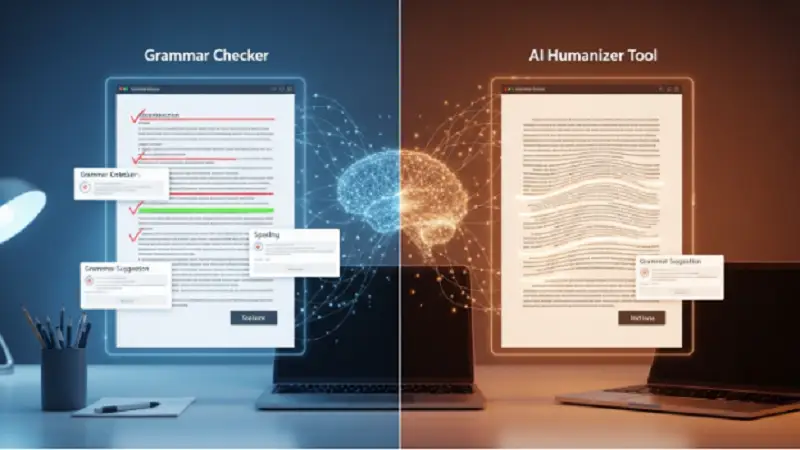
In today’s digital world, writing is no longer limited to writers and journalists. Students, marketers, entrepreneurs, freelancers and business professionals all rely on strong written communication. Emails, blog posts, reports, captions and website copy must be clear, engaging and error-free. As content production increases, so does the need for tools that increase the quality of writing without wasting excessive time. This demand has given rise to two main categories of digital writing assistants: grammar checker and AI humanizer tools.
Although both tools aim to improve written content, they work in fundamentally different ways. A grammar check focuses on fixing mechanical errors such as spelling, punctuation and sentence structure. An AI humanizer tool, on the other hand, improves the tone, flow, and readability of text to make it sound more natural and human. Understanding the differences between these tools is essential for anyone who really wants to improve their writing rather than just polish it.
What a Grammar Checker Really Does
A grammar checker is designed to identify and correct technical errors in writing. It scans the text for spelling errors, problems with subject-verb agreement, misuse of punctuation, awkward phrasing, and sometimes stylistic inconsistencies. These tools rely on rule-based systems combined with machine learning to detect deviations from standard language conventions. For students and professionals alike, a grammar check acts as a safety net, ensuring that careless mistakes don’t reduce credibility.
But while a grammar check can improve clarity and correctness, it doesn’t necessarily increase personality or engagement. It makes sure your sentences are technically correct, but it doesn’t analyze in depth whether your message sounds convincing or authentic. For example, a grammatically perfect paragraph can still seem robotic, repetitive, or emotionally flat. This is where the limitations of traditional correction tools become visible.
The Purpose of an AI Humanizer Tool
An AI humanizer tool goes far beyond surface-level improvements. Instead of just fixing bugs, it restructures the content to make it more natural, conversational and relevant. It focuses on rhythm, intonation variation, vocabulary variation and sentence flow. The goal is not just accuracy, but authenticity.
When authors use AI-generated drafts, the output can sometimes seem mechanical. An AI humanizer tool refines such text by adjusting phrases, reducing repetitions and introducing more human-like transitions. This makes the content more attractive and less recognizable as machine-made. Unlike grammar checks, which focus on correctness, this tool emphasizes natural expression and emotional connection.
Accuracy vs Authenticity in Writing improvement
The debate between the use of grammar checks and AI humanizer tools often focuses on the concept of correction. If proofreading means removing technical errors, a grammar checker performs exceptionally well. This ensures a professional shine and minimizes embarrassing mistakes. For academic or formal business writing, this level of accuracy is important.
But if improvement means making writing dynamic, engaging and relevant, the AI Humanizer tool offers distinct advantages. Modern readers value authenticity. They respond better to content that feels personal than robotic. A technically flawless article can still fail if it lacks warmth or personality. True writing growth often requires both accuracy and emotional depth.
How grammar Checks Enhance Professional Credibility
The business environment demands precision. Whether you’re submitting a report or drafting a client proposal, grammatical errors can damage trust. A grammar checker quickly detects small but important errors that the human eye might miss. This quick response saves time and protects your reputation.
In addition, grammar checker often provide explanations for corrections. This educational element helps users improve their long-term writing skills. By understanding why sentence structure is incorrect, writers become more aware of the rules of language. In this sense, a grammar checker acts as both an editor and a teacher, reinforcing basic writing skills.
How AI Humanizer Tools Improve Engagement
Engagement is the currency of online communication. Blog posts, marketing copy and social media content should attract immediate attention. An AI humanizer tool improves readability by varying sentence length, adjusting tone and refining word selection. This creates smoother transitions and more flow of conversation.
Unlike a grammar checker, which focuses on errors, an AI humanizer tool analyzes overall coherence and emotional impact. It transforms rigid phrases into more fluid language and can adapt its style depending on the type of audience. For digital creators who depend on connectivity and relatability, this tool can significantly increase the effectiveness of their message.
Limitations of Relying on Only one Tool
Relying solely on grammar checker can result in technically correct but uninspiring content. Although the text will be free of grammatical errors, it may still sound boring or too formal. Readers today are sensitive to tone and authenticity, especially when it comes to marketing and storytelling.
Likewise, relying solely on AI humanizer tools without grammar checker can lead to stylistic improvements, but subtle mechanical errors can be overlooked. Even the most attractive paragraph can lose credibility if it contains punctuation errors or unclear sentence construction. Each tool addresses different aspects of writing, and none completely replaces the other.
The Role of AI in Modern Writing Assistance
Both the Grammar checker and AI humanizer tools are products of advances in artificial intelligence and natural language processing. These systems analyze large data sets to identify patterns in language use. Grammar tools focus on rules and structural correctness, while anthropologists focus on contextual and stylistic nuances.
As AI technology advances, the distinctions between these tools may begin to blur. Some platforms integrate grammar correction with tone enhancement features, creating hybrid solutions. But choosing the right tool for your writing goals requires understanding their basic functions.
Academic Writing vs Marketing Content
The type of writing you do plays a big role in determining which tool will benefit you the most. Academic writing prioritizes clarity, logical structure and adherence to language rules. In this context, a grammar check is indispensable. Accuracy and consistency cannot be compromised in scientific work.
In contrast, marketing content thrives on emotional appeal and a motivational tone. Here, an AI humanizer tool can be transformative. It transforms dry, informative text into engaging narratives that encourage action. While grammar still matters, the ability to sound natural and persuasive often takes on greater importance in creative and promotional writing.
Time Efficiency and Workflow Optimization
Writers often work under tight deadlines. A grammar check provides quick corrections, reducing the time spent on manual proofreading. This efficiency is especially valuable in fast-paced business environments. The immediate feedback loop significantly speeds up the editing process.
An AI humanizer tool also contributes to time efficiency, but in a different way. Instead of writing an entire draft from scratch, writers can refine the tone and flow in minutes. This streamlines the creative process, especially when working with AI-generated drafts that require a more personal touch. Both tools increase productivity, but they do so through different mechanisms.
Which Tool Actually Improves Your Writing?
The answer depends on what “improvement” means to you. If your primary concern is to eliminate technical errors and maintain professional standards, a grammar check is essential. This ensures clarity, correctness and structural integrity.
If your goal is to make your writing more engaging, natural, and emotionally resonant, the AI Humanizer tool offers unique benefits. This refines the voice, increases readability and strengthens audience engagement. In fact, the most effective approach to achieving comprehensive improvement is often a combination of both tools.
Conclusion
The comparison between grammar checker and AI humanizer tools highlights two different dimensions of writing improvement: correctness and authenticity. One protects technical precision, while the other enhances tone and engagement. Instead of seeing them as competitors, writers can see them as complementary resources.
As digital communication continues to expand, mastering both accuracy and relativity becomes increasingly important. By understanding the strengths and limitations of each tool, writers can make informed decisions and create content that is not only flawless, but also compelling and human-centric.
See More: betterthistechs.org